Why people bank their voice
Some conditions affect speech over time. In ALS (called MND in the UK), most people eventually can't rely on speech to meet their daily communication needs; estimates range from 80 to 95 percent.1 In interviews, people with MND who chose to bank their voice said the main reason was to keep their identity.2 Some head and neck cancer operations, including laryngectomy, cause permanent voice loss. Parkinson's, MS and some rarer conditions can make speech quieter, slower or harder to understand.
Banking means recording your voice so that a communication device can later use it, either as recordings or as a synthetic voice made from them.
Message banking: recorded phrases
Message banking means recording words, phrases and sounds in your natural voice, saving them, and playing them back later on a communication device.3 Think of nicknames, greetings, catchphrases, "I love you", a laugh, the way you call the dog.
- PlaybackYour real voice, with your own timing, accent and expression.
- LimitsIt can't say anything new. A recording only says what you recorded.3
- Recording timeYou can start with a few phrases and add more later. People in one hospital program banked anywhere from about 150 to more than 4,000 messages.3
Any phone can record a message. Check how you'll play the recordings in your communication app. Ideas for what to record, and how.
Voice banking: synthetic speech
Voice banking creates a synthetic voice from recordings of your speech. Once made, it can say whatever you type or select on a communication device.4 Methods differ a lot in how much they ask of you:
| Approach | What you record | Good to know |
|---|---|---|
| Traditional voice banking services | Usually dozens to thousands of set sentences, often with a laptop and headset microphone | Long-established. Some charge a fee, which ALS and MND charities may cover.5 |
| Cloud voice cloning | From under a minute to many minutes of audio; some can work from old videos or voicemails | Can sound very natural. Some need an internet connection every time the voice speaks.5 |
| Personal Voice, built into recent Apple devices | A set of phrases read aloud on an iPhone, iPad or Mac | Free and kept on the device. How many phrases depends on the device and software version; the voice can be used by apps you give permission to.6 |
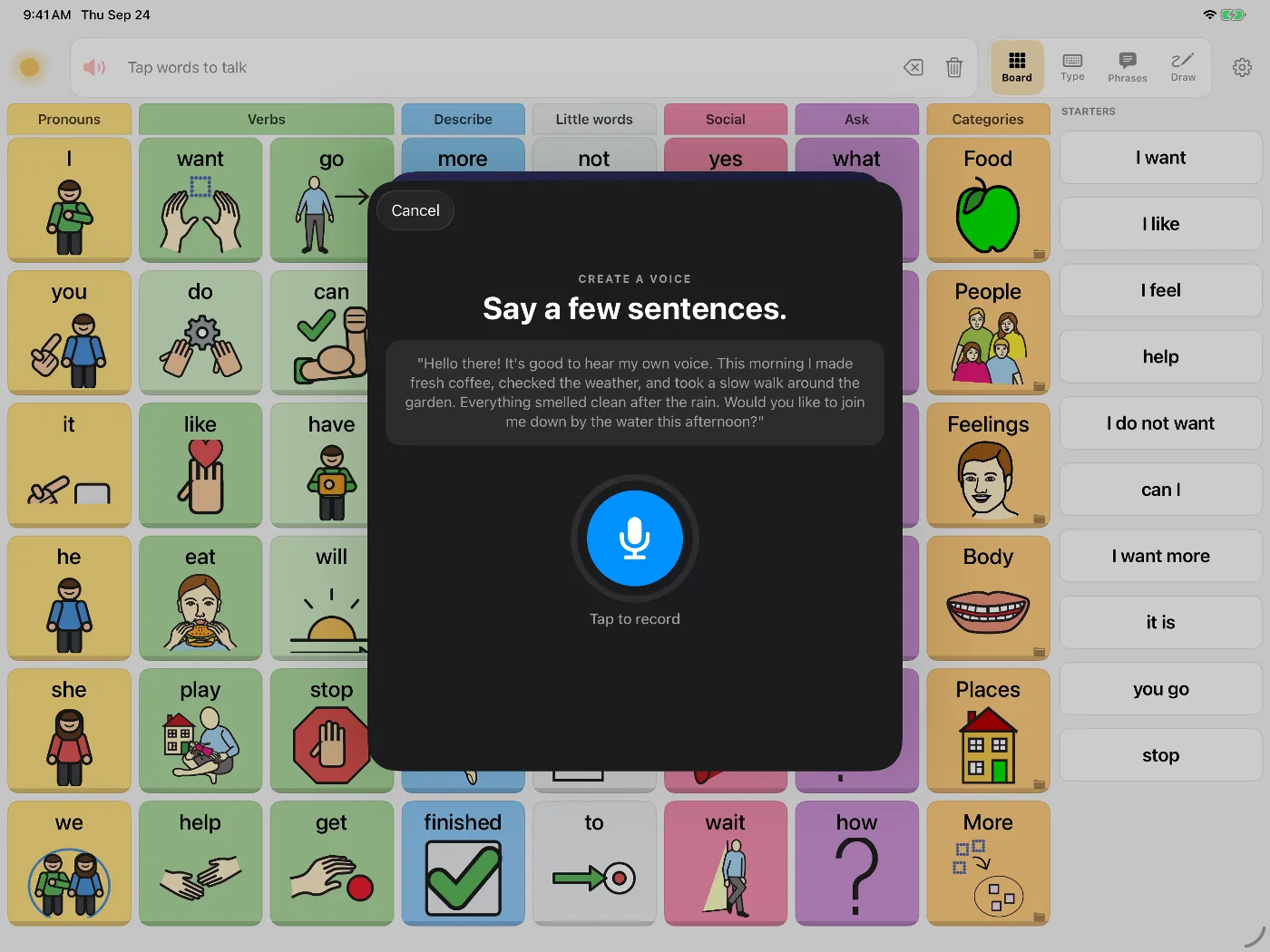
| A voice built inside an AAC app | Varies by app. Dawn needs about eight seconds of reading | Ready to use straight away in the app you'll talk with. Dawn builds and keeps it on the device. |
Whichever you choose, check three things before you spend time recording: where the voice will live (on your device or a company's server), whether it needs the internet to speak, and whether it works in the communication app you plan to use.
When to start
The MND Association advises that the clearer your voice is when you record, the better the banked voice will be.7 You can still bank a voice that has changed, though you'll hear some of those changes in the result,7 and in one large listening study a voice banked from moderately slurred speech still came out clear.8
Record when you're rested, in a quiet room, in your normal speaking voice. There are more recording tips in our message banking guide.
Using a built-in voice instead
You can use AAC without recording your voice. In one interview study, the people who chose not to bank felt a synthetic voice couldn't replace their own.2 A clear stock voice chosen to match your age and accent is the alternative, and most AAC apps let you try several before choosing.
Dawn
Dawn has message banking and voice building in the same app, and the recordings stay on the device. Making a voice in Dawn.