How to start AAC with your child

Start by using the device yourself while you talk to your child during familiar activities, and keep it where they can reach it.

No readiness test

ASHA, the US professional body for speech-language pathologists, says: "There are no prerequisites for AAC intervention," and that everyone is a candidate.1 A review of 114 studies found that AAC helped about as much regardless of a child's age, diagnosis, how many words they had, or whether they could imitate.2 A national committee of experts in the US says communication support should be based on a person's needs, not on arbitrary criteria.3

Your child doesn't need to match pictures, point accurately or sit still first.

Setting up

  1. Choose a starting size. Many children start with fewer words showing and add more over time. In Dawn, Settings, then Layout, then Words to show: "First words" shows about a dozen words, and more appear in their final places as you move up a level.
  2. Lock the settings. Turn on Lock Settings so a curious child can explore the board without changing it.
  3. Pick a voice. Dawn has children's voices; choose one that suits your child.
  4. Pick two or three daily moments. Snack time, bath time, a favourite game, getting dressed.
  5. Model. As you talk, tap one or two key words on the device: "Let's go outside." "You want more?" Don't ask your child to copy you. There are more examples of modeling, and the research on it, in our modeling guide.4 In Dawn, turn on Modeling mode in Partner Tools so your taps don't change your child's word suggestions.
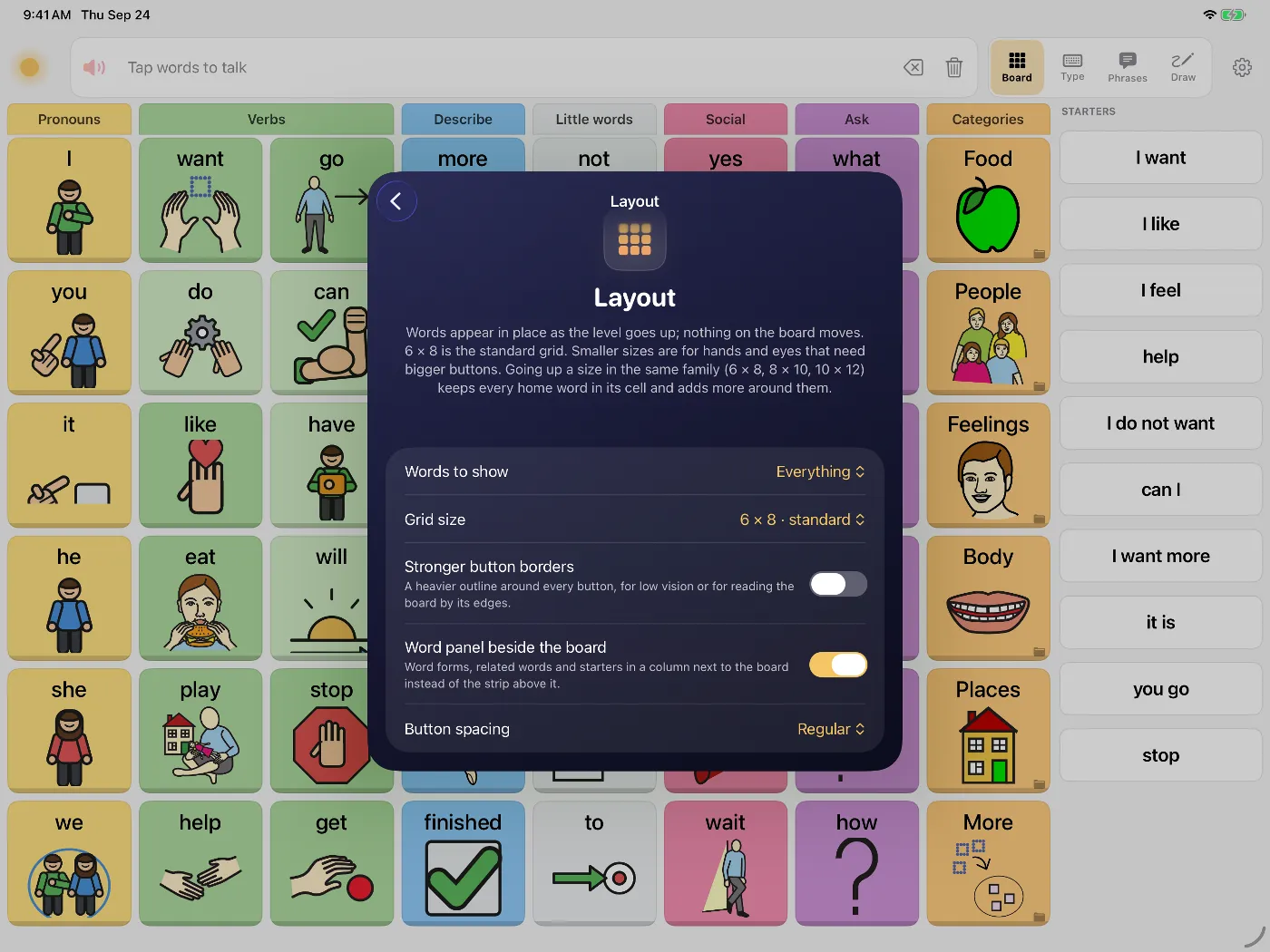
Dawn's Layout settings on iPad, with Words to show and Grid size options
Words to show starts the board with fewer words. New words appear in empty cells as the level goes up.

Using AAC during the day

  • Keep it within reachKeep it beside them at meals, in the car and at the park.
  • Use words in conversationAvoid "Show me apple" or "What's this?" Use the device the way you'd like your child to: to ask, comment, joke and complain.
  • Respond when your child uses itIf your child taps "stop", stop, even if it looks accidental. They learn what the word does by seeing what happens.
  • Go beyond requests"Want" and "more" tend to get modeled most. Research with autistic children shows AAC works well for asking for things; there's less evidence for commenting and chatting.5 Model "funny", "uh oh", "look", "I like", "all done" and "not" too.
  • WaitAfter you model, pause to give your child time to respond.

What progress can look like

There's no set schedule. Early signs to look for include your child watching you tap, touching the device more, pressing a button and looking at you to see what happens, or tapping a word that fits the moment.

Show family and carers how to use it

Show grandparents, siblings, babysitters and teachers how to model a couple of words, so your child sees the device used by more than one person. Our guide on talking with someone who uses AAC is written to share with them, and AAC at school covers getting it into the classroom.

Questions people ask

My child just taps random buttons. Is that a problem?

Usually not. Pressing buttons to hear what they say is how many children find out what's there, a bit like babbling. Respond as if the word might mean something ("Oh, you said 'go'! Shall we go?") and keep modeling.

How long before my child uses it on their own?

It may take weeks or months of modeling before your child uses the device on their own.

Should I take the device away when my child misbehaves?

No. The device is how your child communicates, so it should stay available, including when they're upset or in trouble and have something to say about it.

Do we need a speech-language pathologist to start?

You can start modeling at home without one. An SLP who works with AAC can help choose words and work out how your child will operate the device. Ask for a referral if you need that help.

What if my child talks a bit already?

Keep encouraging every way your child communicates: words, signs, gestures and the device. Our guide on whether AAC delays speech covers the research.

Sources

  1. American Speech-Language-Hearing Association. Augmentative and Alternative Communication (Practice Portal). www.asha.org/practice-portal/professional-issues/augmentative-and-alternative-communication
  2. Ganz JB, Pustejovsky JE, Reichle J, et al. Participant characteristics predicting communication outcomes in AAC implementation for individuals with ASD and IDD: a systematic review and meta-analysis. Augmentative and Alternative Communication, 2023. doi.org/10.1080/07434618.2022.2116355
  3. Brady NC, Bruce S, Goldman A, et al. Communication services and supports for individuals with severe disabilities: guidance for assessment and intervention. American Journal on Intellectual and Developmental Disabilities, 2016. pmc.ncbi.nlm.nih.gov/articles/PMC4770561
  4. O'Neill T, Light J, Pope L. Effects of interventions that include aided augmentative and alternative communication input on the communication of individuals with complex communication needs: a meta-analysis. Journal of Speech, Language, and Hearing Research, 2018. doi.org/10.1044/2018_JSLHR-L-17-0132
  5. Logan K, Iacono T, Trembath D. A systematic review of research into aided AAC to increase social-communication functions in children with autism spectrum disorder. Augmentative and Alternative Communication, 2017. doi.org/10.1080/07434618.2016.1267795

Try Dawn on iPhone or iPad

Symbols, typing and saved phrases, spoken in a natural voice. Dawn can also build a voice from about eight seconds of your own speech.

Requires iOS 17 or later.