AAC for autistic children who don't speak, or speak very little

If your autistic child has few or no spoken words, an AAC app gives them another way to communicate: they tap words or symbols and the app says them aloud. Research with autistic children has found that AAC doesn't hold speech back.

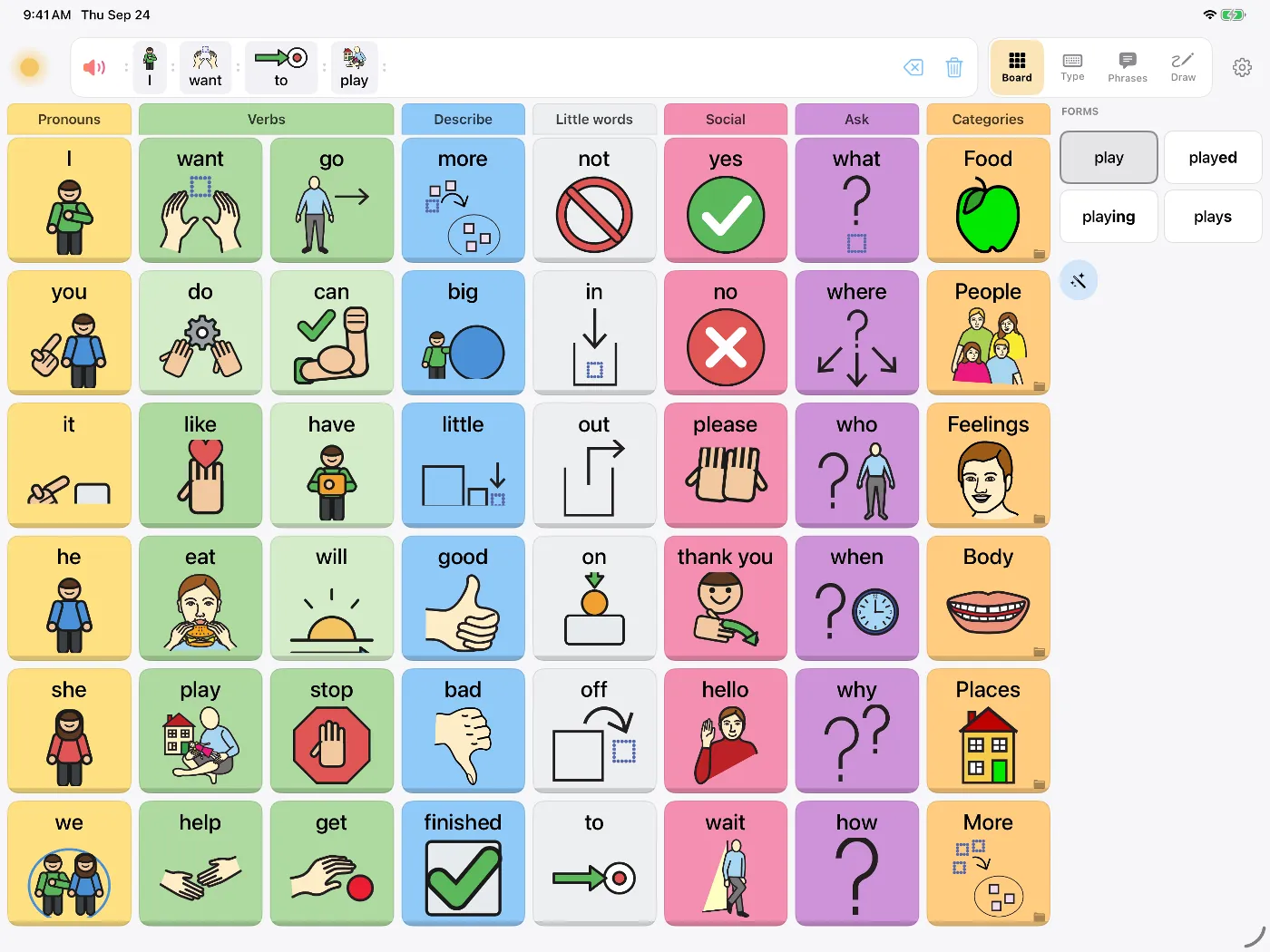
Dawn's symbol board on iPad with the message 'I want to play' built from symbols, and the word forms play, played, playing, plays beside it

An estimated 30 percent of autistic children use few or no spoken words at school age.1 In one community program, about a quarter of children left early intervention using fewer than five spoken words.2

What studies have found

Reviews of studies with autistic children found that AAC did not get in the way of speech, and most studies found speech went up somewhat.34 In a randomized trial with minimally verbal children aged 5 to 8, those whose therapy included a speech-generating device from the start made faster gains in spoken language.5

Children don't need any particular skills before starting.6

Research supports modeling: parents and teachers pointing to words on the child's device while they talk.7 Most studies have looked at children asking for things, and fewer at conversation, so when you model, include comments as well as requests.8

Setting up Dawn for your child

Fixed word positions

Many children find words on the board by where they are, the way you find keys on a keyboard. In Dawn a word stays in its cell until someone moves it, and when the board grows, new words go into empty cells.

Starting with fewer words

"Words to show" starts at First words, about a dozen, then Combining, then Everything. Each word appears in the cell it will keep. Button size is a separate setting, for children who need bigger targets.
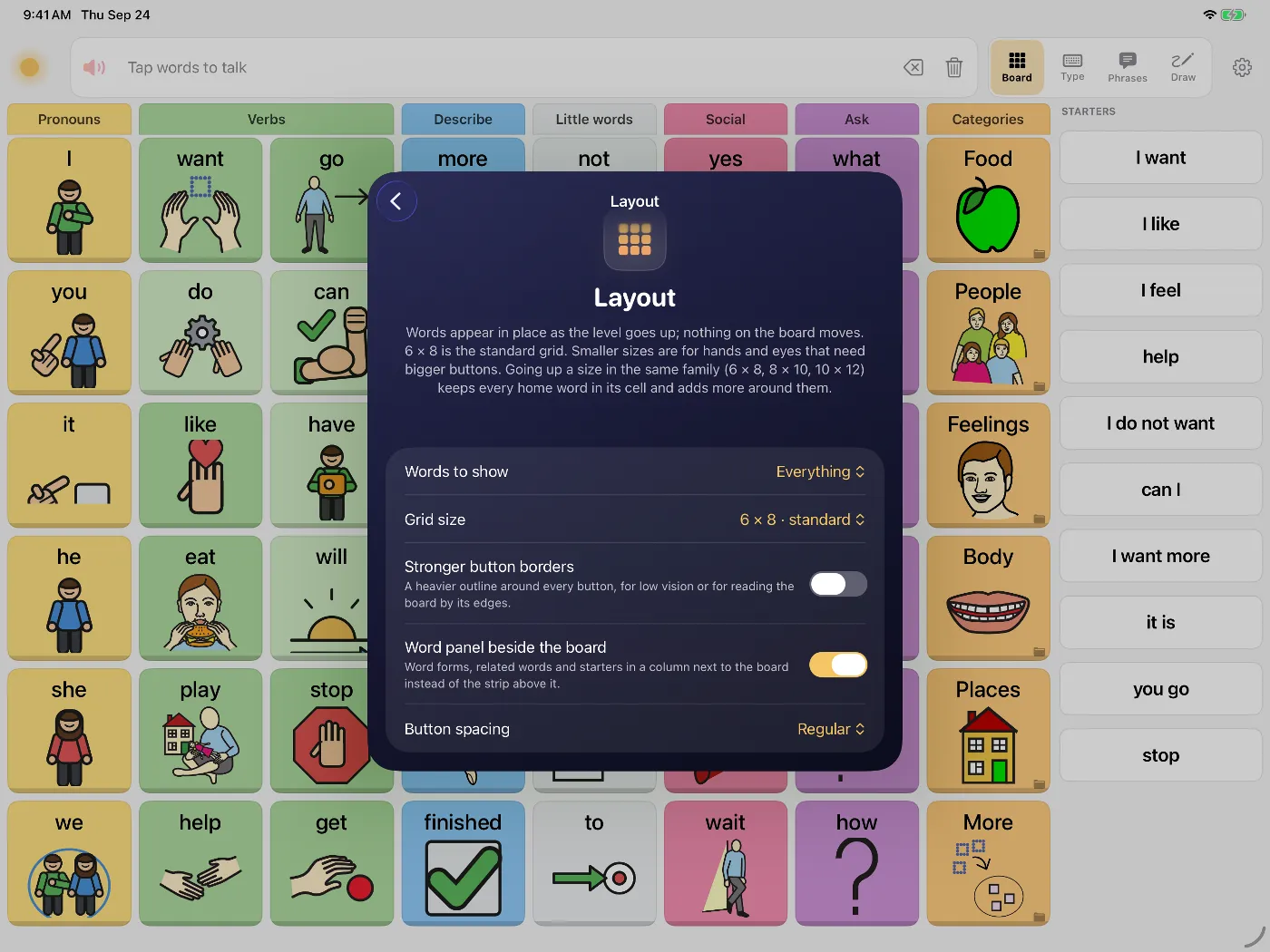
Dawn's Layout settings on iPad: Words to show, Grid size, stronger button borders, word panel and button spacing
Layout settings: Words to show and Grid size are set separately.

Vocabulary

The home board has words that combine into sentences: I, you, want, not, more, help, like, stop, what, where. Folders hold feelings, people, places, food and more, so a child can say "I feel tired", "not that one" or "where's Dad?".
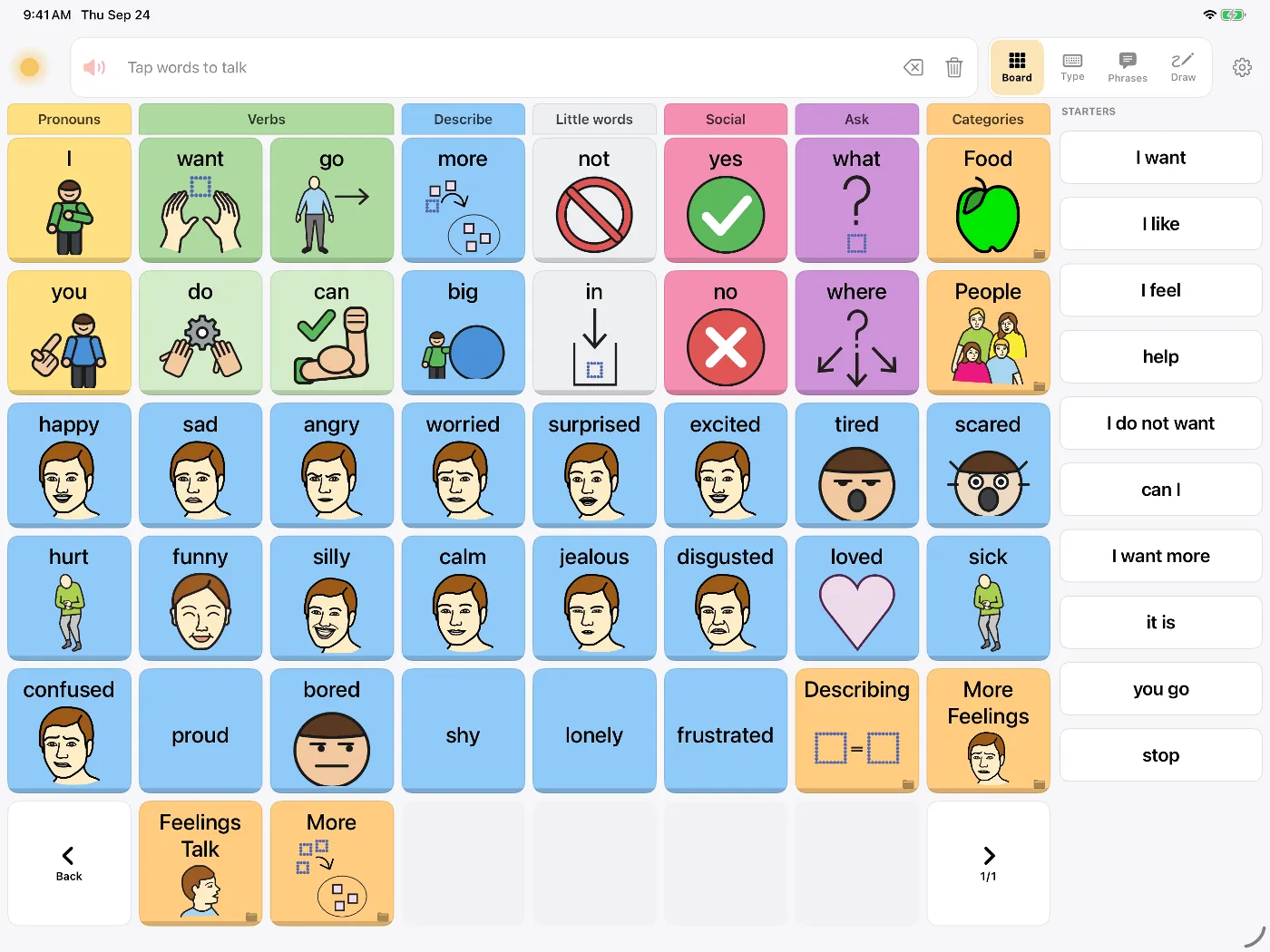
Dawn's Feelings page on iPad with words such as happy, sad, angry, worried, tired, scared, calm and frustrated
The Feelings folder.

Voices

Dawn includes children's voices, and Voice Studio can make any voice sound younger or older. Speech runs on the device, so it works at school or in the car without Wi-Fi.

Settings for parents and therapists

With Modeling mode on, your taps on the board are spoken but don't change your child's word suggestions or usage history. Lock Settings stops a child from getting into Settings by accident. If siblings share an iPad, each can have a profile.
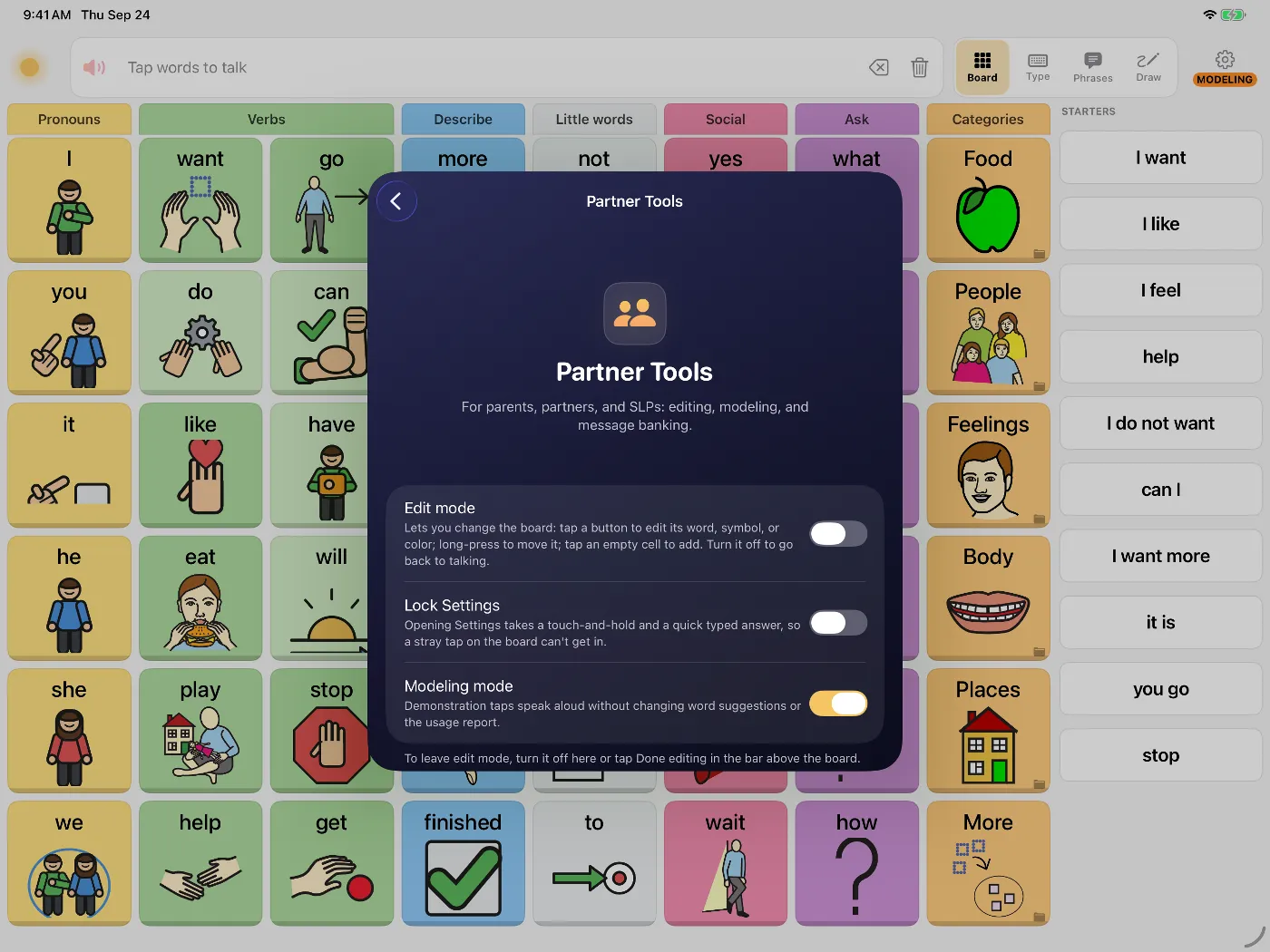
Dawn's Partner Tools on iPad: Edit mode, Lock Settings and Modeling mode, which is switched on
Partner Tools, with Modeling mode switched on.

A first week

  1. Set Words to show to First words.
  2. Choose two or three times a day your child enjoys, like snack time, bath time or a favourite game.
  3. At those times, tap a word or two on the board as you talk: "more", "go", "stop". Don't ask your child to copy you.
  4. Keep the device charged and within your child's reach.
  5. Answer whatever your child taps as if they meant it.

There's more in how to start AAC with your child. Dawn doesn't provide autism treatment; a speech therapist with AAC experience can help you choose words and settings for your child. For teenagers and adults, see AAC for autistic adults.

Questions people ask

Will an AAC app stop my child from learning to talk?

Reviews of studies with autistic children found AAC did not hold back speech, and most studies saw speech increase somewhat.34 The increases were modest, so AAC shouldn't be expected to make a child talk. Our guide Does AAC delay speech? goes through the studies.

Is my child too young, or not ready?

ASHA, the US body for speech-language pathologists, says there are no prerequisites for AAC.6 An analysis of 114 studies reported benefits from AAC across different ages, diagnoses and starting language abilities.9

Is it too late? My child is already at school.

No. In a randomized trial with minimally verbal autistic children aged 5 to 8, therapy that included a speech-generating device from the start led to bigger gains in spontaneous spoken language than therapy with spoken words alone.5

What about PECS or picture cards?

Picture exchange (PECS) and speech-generating devices both have good evidence with young autistic children.10 Some families use cards and an app at different times. A device speaks out loud, which helps get someone's attention across a room or talk with a person who can't read.

My child just taps the same button over and over. Is that OK?

Yes. Repeating and exploring buttons is how many children work out what they do. Keep modeling and leave the device out.

Should we wait until we see an SLP?

You don't need to wait to start modeling at home, but a speech-language pathologist, ideally one with AAC experience, is the right person to assess your child and guide the plan. Bring the app to the appointment.

Sources

  1. Tager-Flusberg H, Kasari C. Minimally verbal school-aged children with autism spectrum disorder: the neglected end of the spectrum. Autism Research, 2013. doi.org/10.1002/aur.1329
  2. Rose V, Trembath D, Keen D, Paynter J. The proportion of minimally verbal children with autism spectrum disorder in a community-based early intervention programme. Journal of Intellectual Disability Research, 2016. doi.org/10.1111/jir.12284
  3. Schlosser RW, Wendt O. Effects of augmentative and alternative communication intervention on speech production in children with autism: a systematic review. American Journal of Speech-Language Pathology, 2008. doi.org/10.1044/1058-0360(2008/021)
  4. White EN, et al. Augmentative and alternative communication and speech production for individuals with ASD: a systematic review. Journal of Autism and Developmental Disorders, 2021. doi.org/10.1007/s10803-021-04868-2
  5. Kasari C, et al. Communication interventions for minimally verbal children with autism: a sequential multiple assignment randomized trial. Journal of the American Academy of Child & Adolescent Psychiatry, 2014. doi.org/10.1016/j.jaac.2014.01.019
  6. American Speech-Language-Hearing Association. Augmentative and Alternative Communication (Practice Portal). www.asha.org/practice-portal/professional-issues/augmentative-and-alternative-communication
  7. O'Neill T, Light J, Pope L. Effects of interventions that include aided AAC input on the communication of individuals with complex communication needs: a meta-analysis. Journal of Speech, Language, and Hearing Research, 2018. doi.org/10.1044/2018_JSLHR-L-17-0132
  8. Logan K, Iacono T, Trembath D. A systematic review of research into aided AAC to increase social-communication functions in children with autism spectrum disorder. Augmentative and Alternative Communication, 2017. doi.org/10.1080/07434618.2016.1267795
  9. Ganz JB, et al. Participant characteristics predicting communication outcomes in AAC implementation for individuals with ASD and IDD: a systematic review and meta-analysis. Augmentative and Alternative Communication, 2023. doi.org/10.1080/07434618.2022.2116355
  10. Ganz JB, et al. Interaction of participant characteristics and type of AAC with individuals with ASD: a meta-analysis. American Journal on Intellectual and Developmental Disabilities, 2014. doi.org/10.1352/1944-7558-119.6.516

Try Dawn on iPhone or iPad

Symbols, typing and saved phrases, spoken in a natural voice. Dawn can also build a voice from about eight seconds of your own speech.

Requires iOS 17 or later.