What are core words?
Core words are the short, common words people use all the time, whatever they're talking about: I, you, it, want, go, like, not, more, help, stop, what, where, in, on, finished. They are mostly pronouns, verbs, describing words and small linking words, and they come up in almost every conversation, for children and adults.
Fringe words are the specific ones: pizza, grandma, slide, dinosaur, Tuesday. They're important, especially the names of people and things a person cares about, but each one is useful in fewer situations.
Why build AAC around them?
"More" works at snack time, on the swing and with music. "Not" can be added to almost anything. "Go" works for cars, for leaving and for starting a game. A food picture is mostly useful at mealtimes.
AAC research has mostly measured children asking for things, with less evidence on commenting, protesting or chatting.1 Core words like "not", "look" and "like" are what children use to comment or refuse.
Why do words stay in the same place?
When you type on a keyboard, your fingers know where the keys are without looking. If "want" is always in the same spot on an AAC board, a child's hand can learn the movement in the same way. This is often called motor planning. If buttons move around, the child has to search again.
For this reason, many AAC apps add new words into empty spaces as a child is ready, rather than rearranging the board.
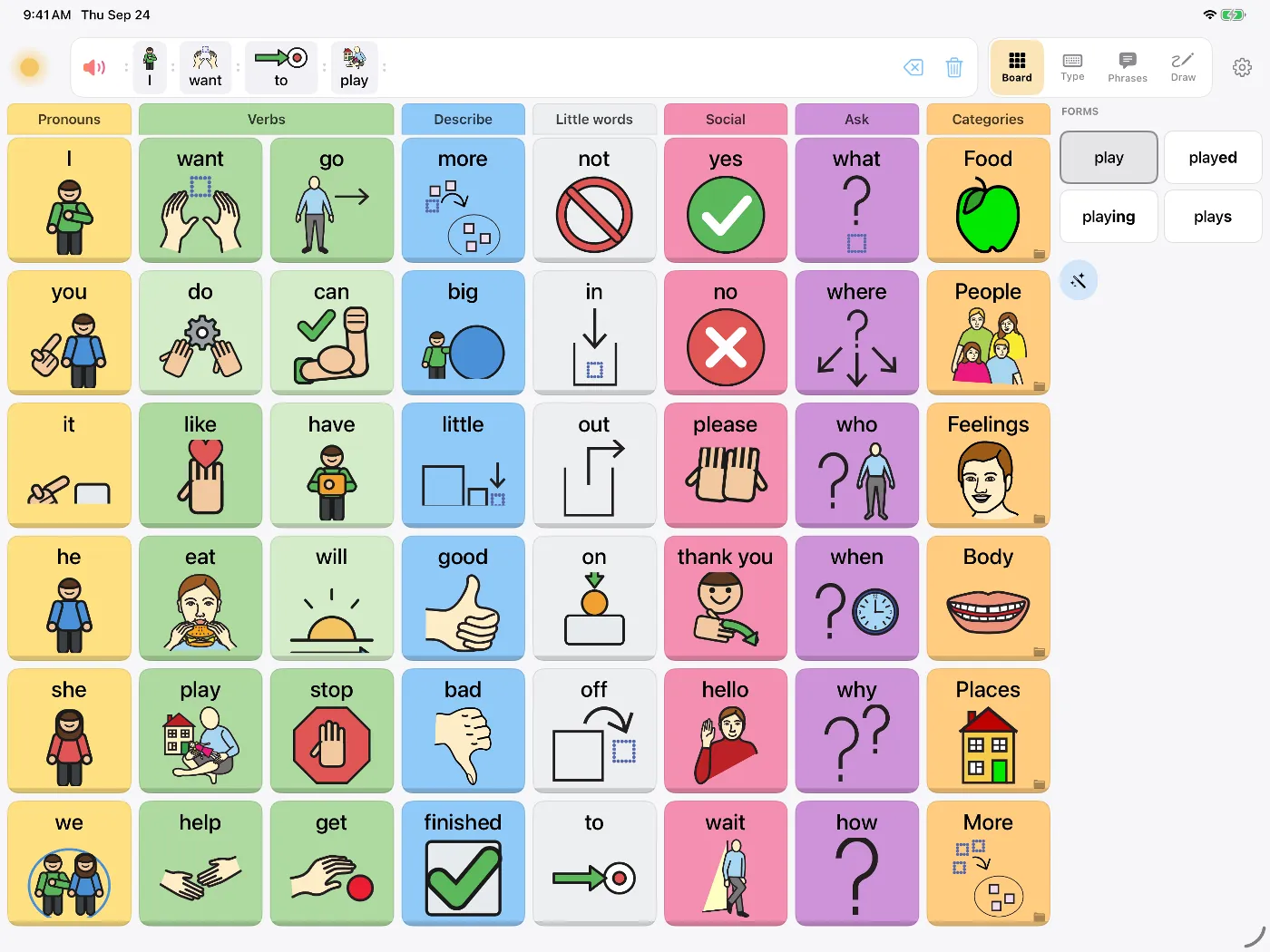
How Dawn's home board is laid out
Dawn's home board puts core words in columns, each with one job:
- PronounsI, you, it, he, she, we.
- Verbswant, go, do, can, like, have, eat, will, play, stop, help, get.
- Describemore, big, little, good, bad, finished.
- Little wordsnot, in, out, on, off, to.
- Socialyes, no, please, thank you, hello, wait.
- Askwhat, where, who, when, why, how.
- CategoriesFolders for food, people, feelings, body, places and more, where the fringe words live.
Because each column has one job, sentences tend to move left to right: I (pronoun), want (verb), more (describe). From the 6 × 8 grid up, the core rows stay on screen when a folder opens, and tapping a word shows its other forms beside the board (go, went, going).
Two-word combinations to model
Once a child is using single words, try modeling two together. These use core words only:
- Asking"want more", "help me", "what that?", "where go?"
- Refusing"not that", "no more", "stop it", "all finished"
- Commenting"big one", "it good", "like it", "it bad"
- Directing"you go", "go in", "turn on", "get out"
- Social"hello you", "thank you", "wait please"
The usual way to teach these is to use them yourself on the device while you talk, which is called modeling. In one research review, modeling helped children combine symbols into longer messages.2 Another found it improved both understanding and expression.3 There are examples of AAC modeling in our modeling guide.