AAC for children with Down syndrome

Many children with Down syndrome understand much more than they can say clearly. Family members learn to follow their speech, but teachers, classmates and strangers often can't. AAC is used alongside signing and speech for those situations.

Dawn's Feelings board on iPad with symbols for happy, sad, angry, worried, excited, tired and more

Children with Down syndrome can be hard to understand when they speak. Muscle tone, mouth shape, hearing and motor planning can all make speech harder to understand, even when a child understands language well. In a survey of 937 parents, being understood was a common problem, especially in sentences and conversation and with people who didn't know the child.1

Research

A systematic review of 13 studies found that AAC tools, most often speech-generating devices and picture exchange, increased children's interaction with others and contributed to quality of life and self-esteem.2

In a small study, four toddlers with Down syndrome all learned to use signs, used them with their parents at home, and gradually used more spoken words.3

ASHA says children don't need to reach any particular level of learning or understanding before trying AAC.4

Signs, speech and an app

Many children with Down syndrome learn to sign early. A child can use signs, speech and an app at different times. The app can say a message aloud when the listener doesn't understand their speech or signs.

When you say or sign a word, you can also show your child its button on the app. The modeling guide explains how.
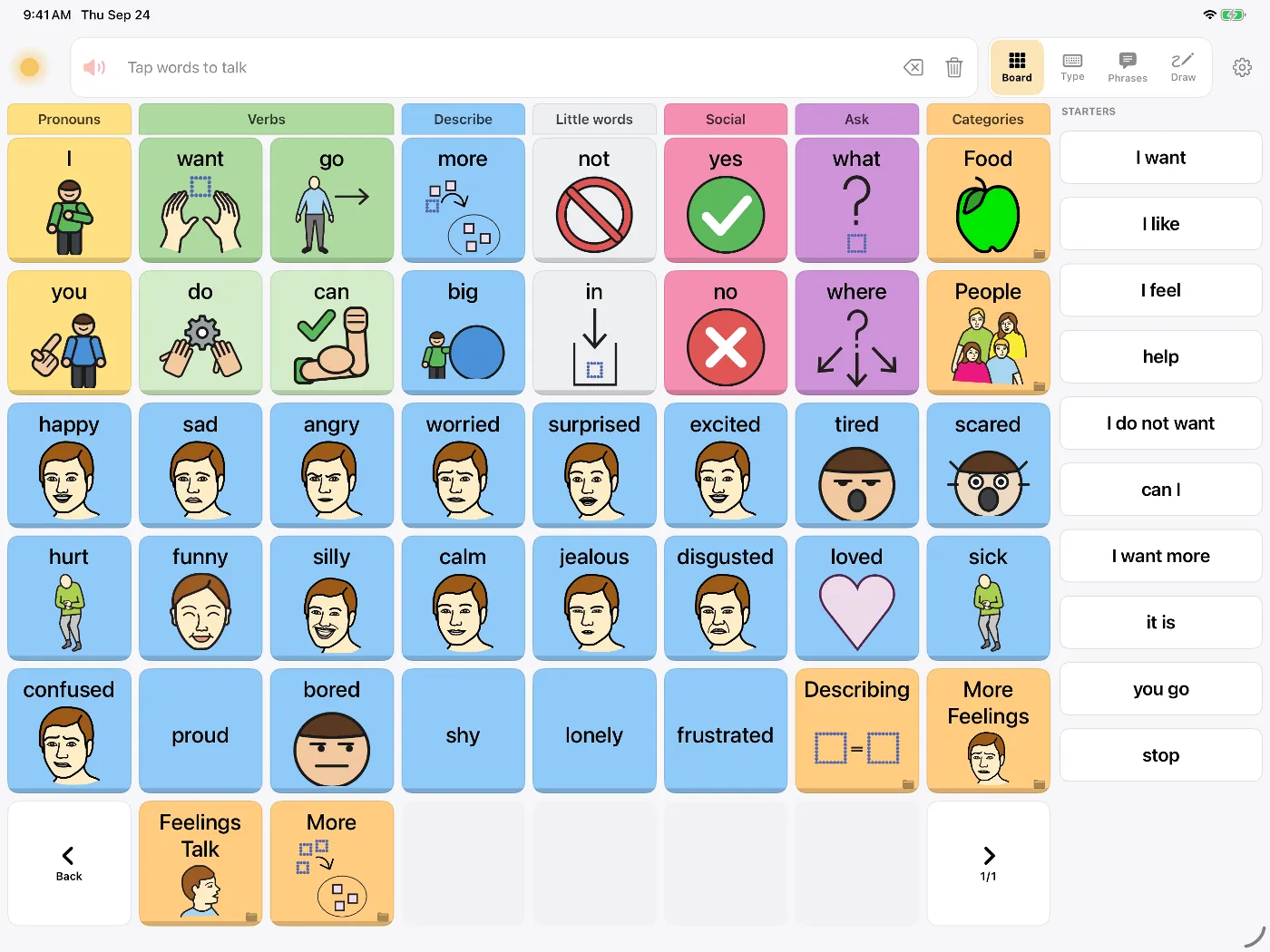
Dawn's Feelings folder with symbols for happy, sad, angry, worried, surprised, excited, tired and scared
The Feelings folder. People, places and food have folders too.

Dawn settings that help

  • Fixed positions. A word stays in its cell until someone moves it, so your child can learn where it is.
  • Words to show. Start at First words and show more later. New words go into empty cells.
  • Photos. Add family, friends, pets and favourite places as photo buttons.
  • Voices. Dawn includes children's voices, and over 900 voices in all, so the voice can change as your child gets older.
  • Keyboard. Word suggestions for children and adults who are reading and spelling.
  • Profiles. Several children can share a classroom iPad, each with their own words and voice.

A speech-language pathologist (speech and language therapist in the UK) can assess your child's speech, hearing and language and help you decide how signing, speech and AAC fit together. Dawn is a way to communicate alongside speech therapy, not a replacement for it.

Questions people ask

My child already signs. Do they need an app too?

Not necessarily. An app is useful alongside signing because it reads messages aloud to people who don't know the signs, and you can add names, places and words used at school.

Will AAC stop my child from talking?

In the studies a review of AAC and developmental disabilities rated most reliable, no one's speech decreased after AAC was introduced, and most people showed modest increases.5 Those studies didn't measure whether speech became clearer.

My child talks a lot at home. Is AAC really for them?

Possibly. In a survey of 937 parents, children with Down syndrome were hardest to understand with unfamiliar adults and in longer sentences.1 Some children use an app only in those situations.

Does Dawn show written words as well as pictures?

Yes. Every button in Dawn shows the written word as well as the picture, and the word is spoken when tapped. Children who are learning to read and spell can also use the keyboard.

Sources

  1. Kumin L. Intelligibility of speech in children with Down syndrome in natural settings: parents' perspective. Perceptual and Motor Skills, 1994. doi.org/10.2466/pms.1994.78.1.307
  2. Barbosa RTA, de Oliveira ASB, de Lima Antão JYF, et al. Augmentative and alternative communication in children with Down's syndrome: a systematic review. BMC Pediatrics, 2018. doi.org/10.1186/s12887-018-1144-5
  3. Wright CA, Kaiser AP, Reikowsky DI, Roberts MY. Effects of a naturalistic sign intervention on expressive language of toddlers with Down syndrome. Journal of Speech, Language, and Hearing Research, 2013. doi.org/10.1044/1092-4388(2012/12-0060)
  4. American Speech-Language-Hearing Association. Augmentative and Alternative Communication (Practice Portal). www.asha.org/practice-portal/professional-issues/augmentative-and-alternative-communication
  5. Millar DC, Light JC, Schlosser RW. The impact of augmentative and alternative communication intervention on the speech production of individuals with developmental disabilities: a research review. Journal of Speech, Language, and Hearing Research, 2006. doi.org/10.1044/1092-4388(2006/021)

Try Dawn on iPhone or iPad

Symbols, typing and saved phrases, spoken in a natural voice. Dawn can also build a voice from about eight seconds of your own speech.

Requires iOS 17 or later.