What does AAC mean?
"Augmentative" means adding to speech. "Alternative" means used instead of speech. ASHA, the US professional body for speech-language pathologists, describes AAC as supporting or compensating for difficulties with speaking and with language.1
For people who can't rely on speech, AAC is the main way they communicate.
What kinds of AAC are there?
AAC is often split two ways.1
- Unaided AACNothing extra is needed: gestures, facial expressions, signs, body language.
- Aided AACSomething outside the body is used: a picture board, a letter board, a notebook, a tablet or a phone.
- Low-tech aided AACDoesn't need power: printed symbol boards, alphabet boards, pen and paper. Useful as a backup and in places a device can't go.
- High-tech aided AACUses electronics, usually with speech: dedicated speech devices and apps on tablets and phones. These are often called speech-generating devices.
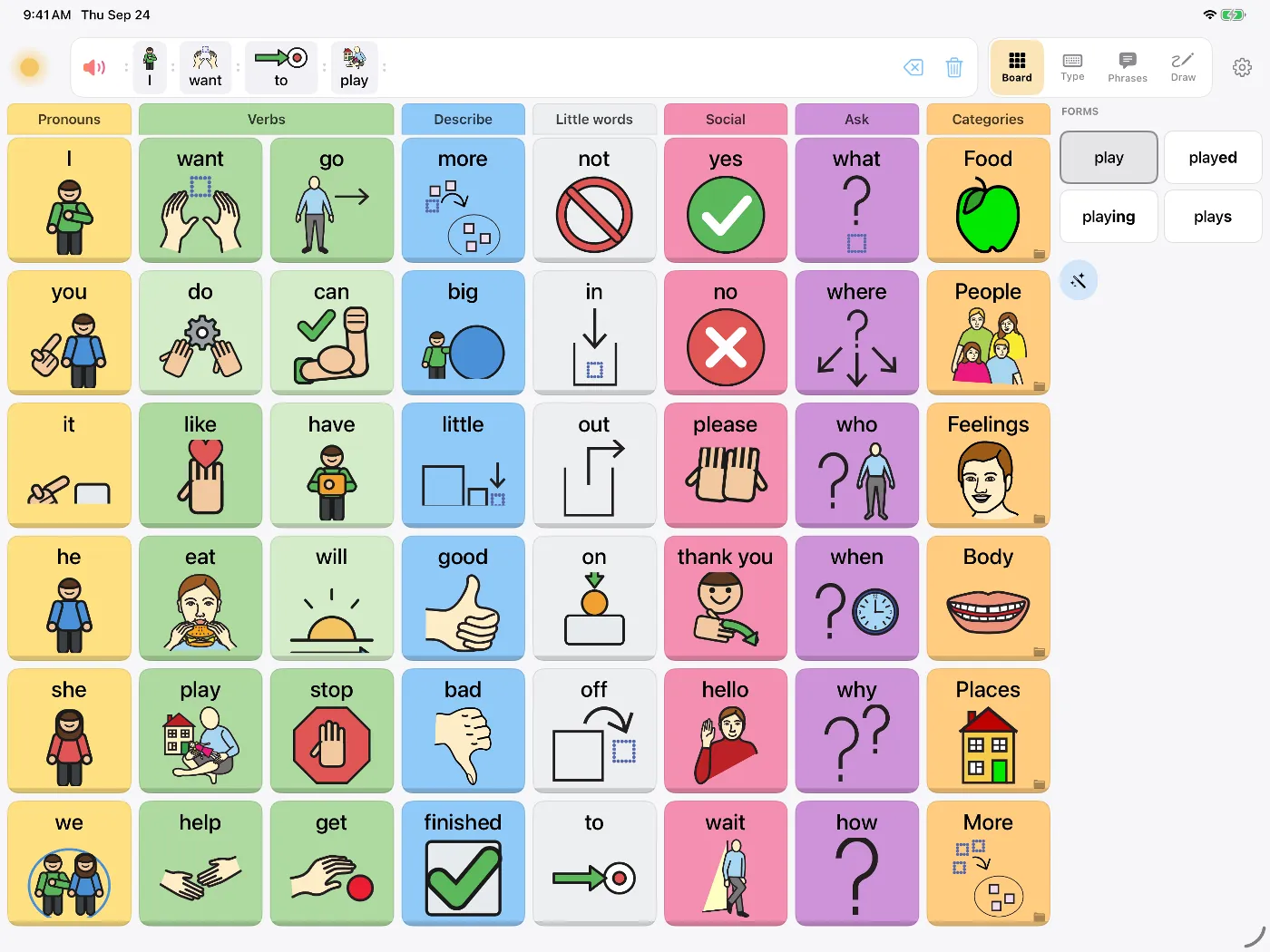
High-tech AAC apps usually offer some mix of three ways to build a message: tapping symbols (pictures with words), typing, and choosing whole phrases that have been saved in advance.
Who uses AAC?
People of all ages. Some are born with a condition that affects speech, such as autism, cerebral palsy, Down syndrome or childhood apraxia of speech. Others lose speech later, through a stroke, ALS (MND), Parkinson's, multiple sclerosis, a brain injury or cancer surgery. Some need AAC for a short time, after an operation or while on a breathing tube.
A UK study estimated that about 1 in 200 people could benefit from AAC.2 A textbook gives estimates of 5 million people in the US and 97 million worldwide; those figures are estimates, not counts from one study.3
Why does speed matter?
People usually speak at somewhere between 125 and 185 words a minute. Communicating with aided AAC is much slower: around 8 to 10 words a minute when pointing directly at buttons, and as little as 2 words a minute when scanning with a switch.4 Pauses of more than about three seconds can make it harder to take a turn in conversation.4
Saved phrases, word prediction and a voice that starts speaking without a delay all help close some of that gap. In research on whole-phrase AAC, faster conversation went together with listeners judging the AAC user as a more competent communicator.5
Does the voice matter?
For years, many AAC users had a choice of only a few synthetic voices, often not matching their age, gender or accent. In an older study from 1989, using the synthetic voices of the time, girls and women judged only natural female voices acceptable as a stand-in for their own.6 In a 2024 study, 831 listeners rated newer voices made with neural networks as clearer and more natural than older synthetic voices, and preferred them.7
People who are losing their speech can also record their own voice to use later. See recording your voice for later use.
Dawn for iPhone and iPad
Dawn is an AAC app for iPhone and iPad. You can tap symbols, type messages, or play saved phrases and recordings.